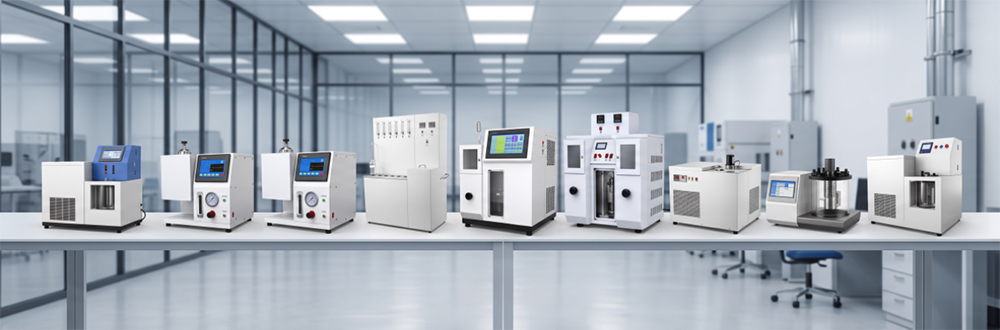
Selecting petroleum testing apparatus can be challenging when catalogs list dozens of instruments under similar names. This guide organizes oil analysis equipment by the test method overseas buyers most commonly search for, helping procurement and laboratory teams make faster, more accurate decisions.
Flash point is one of the most requested tests in fuel and lubricant specification. Buyers typically search for either Cleveland Open Cup (COC) or Pensky-Martens Closed Cup (PMCC) flash point testers. The choice depends on the product and the regulatory method:
ASTM D92 — Cleveland Open Cup, common for asphalt and heavier oils
ASTM D93 — Pensky-Martens Closed Cup, standard for diesel, jet fuel, and lubricants
An automatic flash point tester with precise temperature control and closed-cup detection reduces operator error and improves reproducibility.
Kinematic viscosity is fundamental to lubricant grading and fuel quality. Overseas labs frequently search for kinematic viscosity bath, automatic viscometer, or ASTM D445 viscometer. Key considerations include temperature stability, capillary tube compatibility, and automation level.
With tightening fuel sulfur limits worldwide, sulfur in oil analyzer searches have grown sharply. X-ray fluorescence (XRF) analyzers meeting ASTM D4294 are widely used for diesel, gasoline, and marine fuel. Laboratories requiring lower detection limits often look for ASTM D2622 WDXRF systems.
For hydraulic and turbine oils, oil cleanliness is critical. A particle counter compliant with ISO 4406 provides the cleanliness code needed for oil condition monitoring and wear metal analysis programs. Portable models support on-site oil testing without laboratory delays.
ASTM D86 distillation remains a core test for gasoline, diesel, and jet fuel. Buyers search for automatic distillation apparatus, D86 distillation unit, or petroleum distillation analyzer. Automation in heating control and volume detection is the main differentiator.
Water contamination accelerates oil degradation. Karl Fischer moisture analyzer searches are often paired with ASTM D6304 for petroleum products. Coulometric and volumetric options serve different concentration ranges.
Cold flow properties matter for diesel and lubricants in low-temperature climates. Cloud and pour point analyzer searches typically include the standard number, such as ASTM D97 pour point or ASTM D2500 cloud point.
Standard compliance documentation — request the method reference for each instrument.
Calibration and reference materials — confirm availability of certified standards.
Service and spare parts — especially for distillation, viscometer, and flash point units.
Software and data integrity — LIMS compatibility and audit trails are increasingly required.
Our company manufactures oil analysis equipment covering all the categories above, with configurations matched to ASTM, ISO, and IP methods. Whether you need a single flash point tester or a complete petroleum testing laboratory, we can recommend the right setup.
Request a quote or ask for our standard cross-reference list of instruments and test methods.
 Anna
 +86 155 4112 8603
 anna@zti-dl.com
 No. 8-62, Yingke Road, Ganjingzi District, Dalian, Liaoning, China


 ZT Instruments